

CBN’s New BVN Regulations 2026: Everything Nigerian Bank Customers Must Know Right Now
Introduction: Nigeria’s Banking System Just Changed — Are You Ready?
If you have a bank account in Nigeria, today — May 1, 2026 — is not just another Thursday. It is the day that the Central Bank of Nigeria (CBN) officially rolls out one of the most sweeping overhauls of the Bank Verification Number (BVN) framework in the system’s history.
Whether you bank with a traditional commercial bank, use a fintech app, or operate through a payment service provider, these new rules affect you directly.
Think of it this way: the CBN has essentially replaced the old lock on Nigeria’s banking front door with a brand-new, state-of-the-art security system. The old key — the relaxed, relatively easy-to-manipulate BVN framework — no longer fits. And if you haven’t updated your information or prepared for the changes, you could find yourself locked out of your own financial life.
Don’t panic, though. This article walks you through every single critical update, explains what it means in plain English, and tells you exactly what to do next. Let’s get into it.
What Is a BVN and Why Does It Matter?
A Quick Refresher on the BVN System
The Bank Verification Number is an 11-digit unique identifier that links a Nigerian bank customer to all their accounts across different financial institutions. The BVN is a cornerstone of Nigeria’s financial identity infrastructure, designed to strengthen security, reduce fraud, and build trust in the banking system.
Once you register, your BVN acts like a digital fingerprint — it’s tied to your biometric data, your phone number, and your identity across every bank you deal with.
Since its introduction, the BVN has been a game-changer for financial inclusion and fraud reduction. But as digital banking exploded in adoption and fraudsters evolved their techniques, the old rules simply couldn’t keep up. Enter the 2026 reforms.
Why the CBN Decided to Act Now
The Rise of Digital Fraud in Nigeria
Nigeria has experienced a dramatic surge in digital financial crimes over the last few years. As more Nigerians moved their transactions online — through mobile apps, USSD platforms, and fintech wallets — criminals followed the money.
The CBN’s new BVN regulations signal a tougher regulatory approach to financial security as digital banking adoption continues to rise. For millions of Nigerians, the changes mean greater caution when switching devices, updating phone numbers, or opening new accounts.
SIM-Swap: The Fraud Trick That Triggered This Reform
One of the biggest catalysts for these new rules is the epidemic of SIM-swap fraud.
Here’s how it works in simple terms: a fraudster walks into a telecom outlet, pretends to be you, reports your SIM as lost, and gets a replacement SIM with your number. Once they control your phone number, they intercept OTPs (one-time passwords), bypass two-factor authentication, and drain your bank account — sometimes within minutes.
Banks have repeatedly identified compromised phone numbers as one of the major channels through which criminals infiltrate customer accounts. The new CBN framework attacks this problem directly and aggressively.
Breaking Down the 5 Key New BVN Rules
Rule 1 — One-Time Phone Number Change: Choose Wisely
This is perhaps the most significant rule in the entire package.
Under the new framework, individuals will be allowed to change the phone number linked to their BVN only once in a lifetime.
Customers are advised to link their BVN to a secure, long-term phone number, preferably one already tied to their National Identification Number (NIN).
Why is this such a big deal?
Because previously, fraudsters could exploit the ease of changing BVN-linked phone numbers as part of SIM-swap schemes. By making it a one-time action, the CBN is essentially saying: pick your number carefully, because you won’t get another shot.
If you haven’t updated your BVN phone number yet and you’re using an old or insecure number, now is the time to act — through your bank, not third-party agents.
Rule 2 — The One-Device Policy for Mobile Banking Apps
Have you ever used your banking app on two phones at the same time? Those days are over.
The CBN has introduced a strict one-device-per-app policy, meaning customers can only actively use their banking app on one device at a time. Once you log into a new phone, the previous device is automatically logged out.
Starting July 1, 2026, users will also be required to complete full re-authentication before regaining access when switching devices.
Rule 3 — ₦20,000 Transaction Cap on New Devices
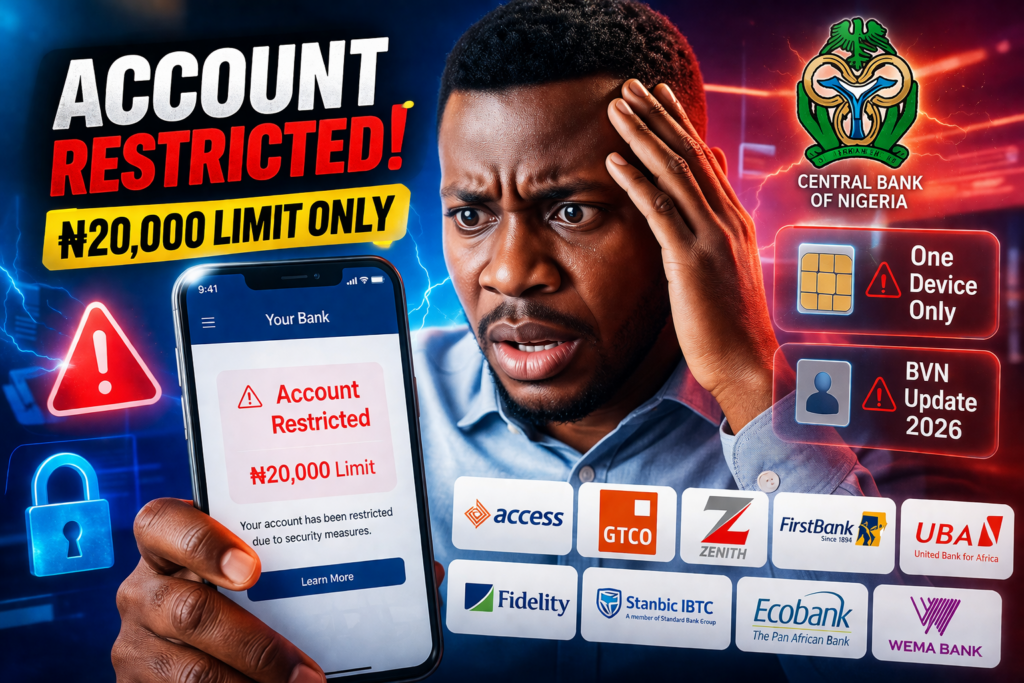
The CBN is introducing a new security measure that places a ₦20,000 transaction limit on digital banking apps for the first 24 hours when accessed from a new device.
So even if someone gains access to your account, they cannot immediately withdraw large sums.
This restriction gives you time to detect suspicious activity and respond.
Rule 4 — The 24-Hour Fraud Watchlist
A key pillar of the new guidelines is the introduction of a proactive fraud watchlist.
If your BVN is linked to a suspicious transaction, it may be placed on a temporary watchlist for up to 24 hours.
During this period, certain transactions may be restricted while investigations are carried out.
This system acts as a safety barrier — slowing down fraud while allowing legitimate users to verify their identity and regain access.
Rule 5 — Minimum Age of 18 for BVN Enrollment
BVN enrollment is now restricted to individuals aged 18 and above.
Minors cannot hold independent BVNs and must operate accounts under parental or guardian supervision.
Who Do These Regulations Apply To?
The new directives apply to:
- Commercial banks
- Fintech platforms
- Payment service providers
- All licensed financial institutions in Nigeria
Whether you use a traditional bank or a digital wallet, you are affected.
Data Privacy: Who Can Access Your BVN Data Now?
Only licensed financial institutions are allowed to access BVN data.
This is aimed at preventing unauthorized access and protecting customers from fraud.
Customers should always go through official bank channels for any BVN-related request.
What You Should Do Right Now
- Check your BVN-linked phone number
- Update it if necessary (this is your only chance)
- Choose your primary banking device
- Keep your contact details updated
- Avoid third-party agents
- Review children’s bank accounts
What This Means for Nigeria’s Financial Future
These reforms are designed to strengthen Nigeria’s financial system, reduce fraud, and build long-term trust in digital banking.
While they may introduce some inconvenience, they ultimately create a safer and more reliable banking environment.
Conclusion
The CBN’s new BVN regulations, effective May 1, 2026, mark a major turning point in Nigeria’s financial system.
From the one-time phone number change to device restrictions and fraud monitoring systems, every rule is designed to improve security and protect users.
The key takeaway is simple: act now, stay informed, and secure your banking setup.
FAQs
1. Can I change my BVN phone number more than once?
No. You are only allowed one change in your lifetime.
2. What happens if my account is flagged?
Your account may face temporary restrictions for up to 24 hours.
3. Can I use multiple devices?
Only one device at a time, but you can switch with re-authentication.
4. What about minors’ accounts?
They must be managed by a parent or guardian.
5. Are fintech apps affected?
Yes. All licensed financial platforms must comply.
